

Every day, our emergency call centres receive hundreds of accidental 9-1-1 calls, where someone has dialed 9-1-1 by mistake. When Next Generation 9-1-1 launches, E-Comm will be introducing a new way of managing these types of calls. That’s because the new digital technology will be able to detect even more of these calls, even those that hang up quickly before reaching a call taker.
A new automated system will ensure every abandoned call to 9-1-1 receives a call back. The system will provide options to report the call as accidental or connect with a call taker if help is needed. This will help increase public safety, while keeping call takers available to respond to active emergencies.
Here’s how the new system will work:
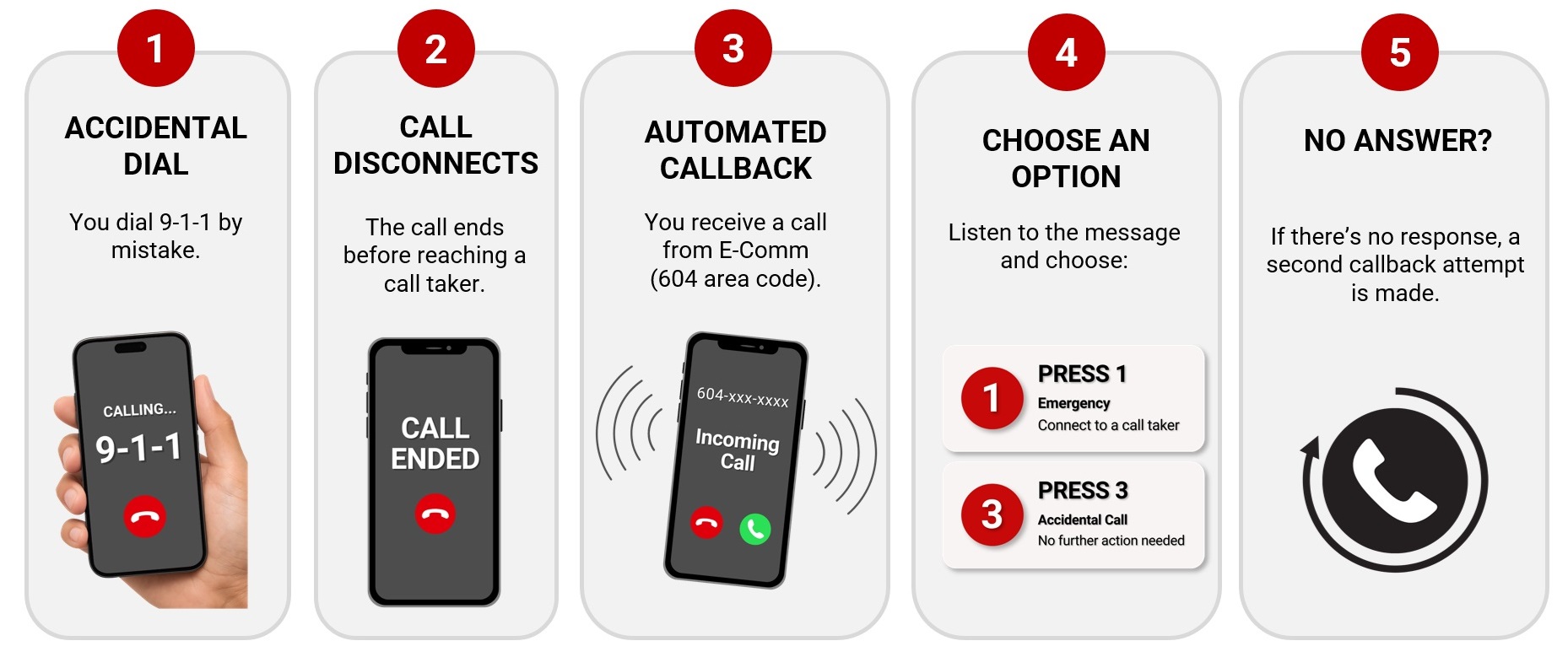
If you receive a call from the automated system, it will show up as a ten-digit number on your phone with a 604-area code.
Frequently Asked Questions
Will the automated callback system be activated for all abandoned calls?
The new system will not be used to respond to open line abandoned calls, where the call reaches an call taker before disconnecting. For those abandoned call types, a call taker will continue to place two manual call backs as they do today, based on standard operating procedures.
When will the new automated callback system launch?
The system will launch during the first phase of the transition and is expected to be operational for 9-1-1 callers within the 25 regional districts E-Comm services by Fall 2026.
What happens if the caller doesn’t pick up the automated call, or doesn’t select one of the options?
No further action will be taken, which is aligned with the current call back practice when a caller doesn’t pick up or voicemail is reached. The new system will follow the same procedure for both cell phone and landline calls. For open line abandoned calls with no response, call takers will continue to follow current policies based on the relevant police of jurisdiction.
Is there a risk some true emergency calls could be missed if there is no response to the automated call back?
The automated system will ensure all quick hang ups prior to call taker pick-up receive an automated call back, unlike today. Currently, some very quick hang ups do not receive a call back, as their call information never comes through to E-Comm. While no system can eliminate risk entirely, automated call backs for quick hang ups will also allow call takers to focus on active emergencies. Similar automated callback systems for quick hang up calls are already in use in other jurisdictions across the country, including Peel Region and Toronto, with the technology operating successfully in Canadian communities.
Does the automated system recognize voices or background noise?
Voice and sound recognition are not expected to be initial features of the system; however, these functions will be sought for future iterations of the software.
What will people see on their phone displays when automated system calls, and how will they know the call is legitimate?
A call back from the automated system will display as a ten-digit number beginning with a 604-area code. If someone calls the number back, they will hear a message indicating they have contacted E-Comm and to call 9-1-1 if there is an emergency.
Will the automated callback system have options for those who speak languages other than English?
The system’s initial phase will incorporate English-language messaging only. E-Comm recognizes that some callers may experience language barriers when receiving an automated callback, which is why we are creating a public education campaign for the new system so that callers who get this recording, despite having a language barrier, can press 1. If someone contacts 9-1-1 and requires service in a language other than English, our call takers can access a 24-hour interpretation service for over 200 languages.
How will the new automated system work for those who are deaf/hard of hearing?
Accessibility services including Text with 9-1-1 and Teletype Writers (TTY) will continue to be available with the launch of Next Generation 9-1-1.
For Text with 9-1-1, when a 9-1-1 call is made from a registered user, the call taker receives an alert and will initiate text communication. In the event a 9-1-1 call from a registered user was quickly hung up before connecting to the call taker, the system would place up to two automatic calls back. Future capabilities may include other methods of contact other than a voice recording, including text messages.