

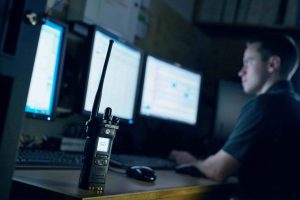
What is E-Comm and what does it do?
- E-Comm operates two 9-1-1 centres in B.C: one is in the Lower Mainland (in Vancouver) and one is on Vancouver Island in Saanich.
- We’re responsible for 99 per cent of the province’s call volume.
- In 2025, we received over 2 million 9-1-1 calls.
- We provide 9-1-1 service for 25 regional districts spanning from Vancouver Island to the Alberta and U.S. borders, to north of Prince George.
- We provide dispatch service for more than 70 police agencies and fire departments in B.C.
- We own and operate the largest multi-jurisdictional, tri-service emergency radio system in the province used by police, fire and ambulance personnel within Metro Vancouver.
- Police, fire and ambulance agencies using the E-Comm Wide-Area Radio network in Metro Vancouver and the Fraser Valley make approximately 3.9 million radio transmissions each month.
- E-Comm has more than 650 full-time and part-time employees.
- E-Comm provides a variety of secure, mission-critical technology services such as multi-jurisdictional computer-aided dispatch systems, records management systems and electronic mapping services.
- E-Comm’s technology service desk operates 24/7 to ensure continuity of service to its partners and staff in fulfilling their public safety missions.
How does a 9-1-1 call work?
- When you dial 9-1-1, an E-Comm 9-1-1 operator will ask if you need police, fire, or ambulance, and for what city or municipality.
 The 9-1-1 operator will then transfer your call to the appropriate agency where a call taker will take the details of your emergency to have dispatched to first responders on the ground.
- Depending on location, your call may be transferred to a call-taker and dispatcher right within E-Comm, or an agency outside of E-Comm that does their own call-taking and dispatch services.
- Medical calls requiring ambulance are transferred directly to BC Emergency Health Services (BCEHS) for medical call-taking and dispatch.
Who owns E-Comm?
- E-Comm is owned by its shareholders and operates on a not-for-profit/cost recovery basis.
- The money to run E-Comm comes from: fees collected from member agencies that use the radio network, revenue from agencies that use E-Comm’s dispatch services and revenue from regional districts and communities that use E-Comm to answer 9-1-1 calls.
- Most regional districts/communities fund 9-1-1 through property taxes, however some use other methods such as call-answer levies.
- Shareholders include municipalities, police boards and BC Emergency Health Services (ambulance service).
- As a cost-recovery model, E-Comm is not structured to make a profit.
- E-Comm’s formal name is Emergency Communications for British Columbia Incorporated.
Who runs E-Comm?
- A nine-member executive leadership team runs the day-to-day operations of E-Comm.
- A 23-member Board of Directors governs E-Comm and is responsible for overseeing the Corporation’s strategic direction, finances and operating results
- Management is accountable to the Board of Directors
Where is E-Comm?
- E-Comm operates two purpose-built facilities. One is located in East Vancouver, and the other is located in Saanich. Both are post-disaster buildings that are earthquake resistant.
When did E-Comm start?
- E-Comm began operations 1999. E-Comm is governed under the Emergency Communications Corporations Act (1997) and incorporated under the BC Business Corporations Act.
What role do call takers and dispatchers play in emergency services?
- Call takers and dispatchers are a vital link in emergency response. They coordinate all communications between 9-1-1 callers and police officers, firefighters, and paramedics to ensure a safe, swift and appropriate response.
What is the difference between a call taker and a dispatcher?
- A call taker speaks with the person who has dialed 9-1-1 and a dispatcher speaks with the emergency personnel in the field. In some cases, the dispatcher will speak to the caller as well. The call taker and dispatcher work together, using computer and radio systems to share information instantly and seamlessly.
What technology supports dispatchers?
- E-Comm call takers and dispatchers use computer-aided dispatch (CAD) systems to ensure that call details are automatically transmitted from the call taker to the dispatcher. CAD systems allow the 9-1-1 call taker to be on the line with the caller while a dispatcher is mobilizing units to help.