

Happy holidays from E-Comm
Watch this special holiday message from E-Comm’s President and CEO Oliver Grüter-Andrew.
The children of E-Comm staff members have also created some holiday artwork. Take a look on our Facebook page.

Watch this special holiday message from E-Comm’s President and CEO Oliver Grüter-Andrew.
The children of E-Comm staff members have also created some holiday artwork. Take a look on our Facebook page.
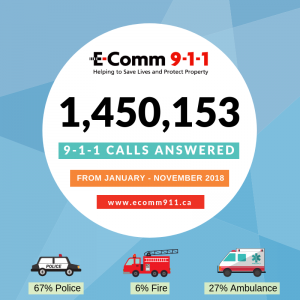
So far in 2018 (to the end of November), E-Comm’s provincial 9-1-1 call volume is 1,450,153:
Our service level target is to answer 95 per cent of 9-1-1 calls in five seconds or less. To the end of November, our service level is 98 per cent. The total number of 9-1-1 calls are for E-Comm’s service area: 26 regional districts and communities spanning from Vancouver Island to Alberta and from the U.S. borders to north of Prince George.
Find out more about our 9-1-1 call statistics.
We also received a total of 40 Text with 9-1-1 (T9-1-1) calls so far in 2018. T9-1-1 is a specialized texting service available for people who are Deaf/Deaf-Blind, Hard-of Hearing or Speech Impaired (DHHSI) that allows registered users to communicate with 9-1-1 call-takers through text. Find out more about T9-1-1.
The fall 2018 edition of e-communiqué, E-Comm’s quarterly stakeholder newsletter, is now available online and in PDF format. Check out our publications page to view previous issues.
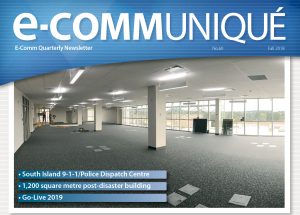
In this edition you’ll find:
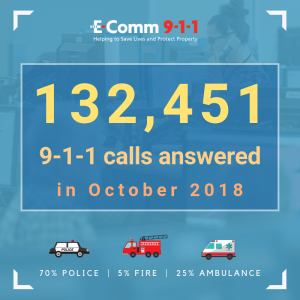
In October 2018, we’ve answered 132,451 9-1-1 calls.
So far in 2018 (to the end of October), E-Comm’s provincial 9-1-1 call volume is 1,324,951:
Our service level target is to answer 95 per cent of 9-1-1 calls in five seconds or less. To the end of October, our service level is 98 per cent. The total number of 9-1-1 calls are for E-Comm’s service area: 26 regional districts and communities spanning from Vancouver Island to Alberta and from the U.S. borders to north of Prince George.
Find out more about our 9-1-1 call statistics.
We also received four Text with 9-1-1 (T9-1-1) calls in October, for a total of 40 calls so far in 2018. T9-1-1 is a specialized texting service available for people who are Deaf/Deaf-Blind, Hard-of Hearing or Speech Impaired (DHHSI) that allows registered users to communicate with 9-1-1 call-takers through text. Find out more about T9-1-1.
Halloween is just around the corner! It’s a fun and spooky time of the year with many exciting events – which is why it’s also important to know when and when not to call 9-1-1.
Here are some tips on what to do when calling 9-1-1:
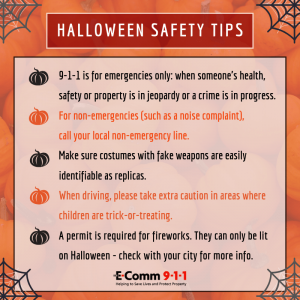
Learn more about the 9-1-1 tips and information.